
A North Star Metric can be a valuable tool for a startup founder. When done right, it can have a few very important benefits:
- Provide a simple yardstick to demonstrate growth
- Foster a growth mindset throughout the company
- Focus attention on the right problems (thus avoiding many potential friction points)
In this article, I’ll share thoughts on what makes a good north star metric, how to structure rituals to leverage it, and elaborate on how doing so helps you achieve the benefits above.
What Makes A Good North Star Metric?
As Paul Graham eloquently described, “a startup is a company designed to grow fast.” Perhaps the most valuable purpose of a North Star Metric (NSM) is to provide a simple and powerful yardstick to demonstrate this growth.
In order to do this, a strong NSM will be:
✅ Valuable – Tied directly to the value customers or users receive.
✅ Actionable – Straightforward, and something your team can influence in short iterations.
✅ Investable – If it grows, it makes your company more compelling.
The internet is full of great examples from AirBnb, Uber, Hubspot, et. al. In all cases you see that it is concise, easy to understand, and clearly meets the criteria above.
See examples here…
- Airbnb: Number of nights booked
- Spotify: Time spent listening
- Dropbox: Number of files uploaded
- HubSpot: Weekly active teams
- Shopify: Active merchants
- Asana: Weekly active subscribers
- Salesforce: Average records created per account
- Uber: number of rides completed
- Linkedin: daily active users
- Netflix: total watch time
- Amazon: number of purchases per month
💡 Note that they are rarely expressed as an average and never expressed as a percentage.
Should Revenue be Your North Star?
Revenue (or Gross Market Value for marketplace products) can work well, and should probably be your default. It is certainly tied to value and investable. It works great for a product with simple sales process. However, there are a few reasons to consider alternatives.
The most common reason to veer from revenue is that it may not be “actionable” early on or by everyone in your company. Your product may be too immature to charge a fee, or it may have a sales cycle too long to be measurable on a short iterative timeline. You may also want to prioritize user acquisition for network effects, or to hone your value creation before increasing your value capture.
How Do You Implement an NSM?
As important as the metric itself are the rituals built around it. Some recommendations on how to make the best use of it.
- Set a target and graph a tracking line so you know the weekly or monthly growth needed
- Publicly commit to it and hold yourself and team accountable
- Do things that don’t scale to hit it
- Use misses as learning opportunities
Set a target
To set the target, think both top-down and bottom-up. This means consider both how fast it should evolve on each iterative cycle, and what it should look like over a substantial period of time.
For example:
- Y-Combinator suggests 5% - 10% Week Over Week (WoW) growth, and culminates after 3 months.
- When I led DoubleGDP, we used 10% WoW for weekly active users and later switched to “population” as our north star with a target of 20% Month-over-Month growth. See more background on DoubleGDP and how our metric evolved over time.
Consider what would impress investors, customers, and yourselves at the end of the year or at the next fundraise. Imagine how achieving this singular metric will impact the story you tell, and how you can celebrate with your team.
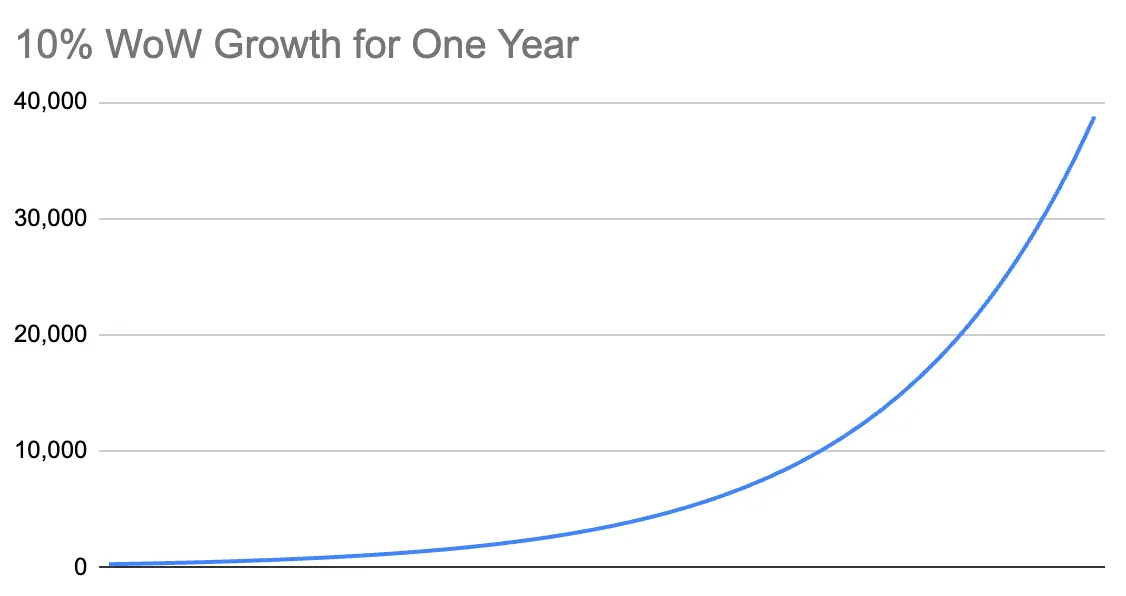
As you can see, growth of a good NSM — one that’s Valuable, Actionable, and Investable — starts a compelling story immediately.
To set your target, map it out on a graph just like this so you have clarity on the end goal, and what “on track” looks like at each weekly or bi-weekly iteration along the way.
Commit to your target
There’s nothing like public accountability and committing to a target may involve putting this burden on your back intentionally.
I recommend you talk openly with your whole company, existing investors, and advisors at every sprint update. It creates an accountability that builds clarity of purpose and a rallying point around inevitable setbacks.

I’m reminded of Hernan Cortes’ decision to burn his boats as a means to motivate his troops to build settlements in the new world rather mutiny and return to the comforts of Spain. (You don’t need to be this extreme.)
Do Things That Don’t Scale
Paul Graham argues you should do things that don’t scale. The founders of AirBnb did business development by knocking on doors and hired professional photographers to improve their early listings. At DoubleGDP we created artist and software engineering residency programs with our early city partners to better attract first tenants to new community developments.
The activities that you do that don’t scale have the best potential to expose you to the real-world problems that your product cannot alone solve. By tackling them, you both:
- Increase the value that your early customers receive, and
- Gain the expertise of the full solution
Use Misses as Learning Opportunities
The other aspect of doing what it takes is in handling the inevitable misses. You will miss the target sometimes, and these become very important cultural moments. When this does happen, bring your full company to bear on the problem in a root cause assessment. What caused the miss? What can you do to get back on track?
Now, drop whatever you had planned and instead do the things that will get you on track.
Conclusion
Running a startup is hard. A North Star Metric can help.
- It can align everyone around a common objective and provide a simple and concise yardstick for your growth.
- Leveraging it to guide you when to do things that don’t scale and utilizing misses to adjust will help everyone focus on the right problems.
All in all, it can be a powerful and simple anchor point to focus your company on what truly matters: growth.