

I led DoubleGDP as CEO for three years, from 2019 through 2022. We were an end-to-end platform for “new cities” (planned urban development startups) to connect with residents, accelerate growth, and deliver responsive public services. We built a CRM that ran daily operations in 5 cities in Africa and Latin America.
Initial Deployment - Weekly Active Users
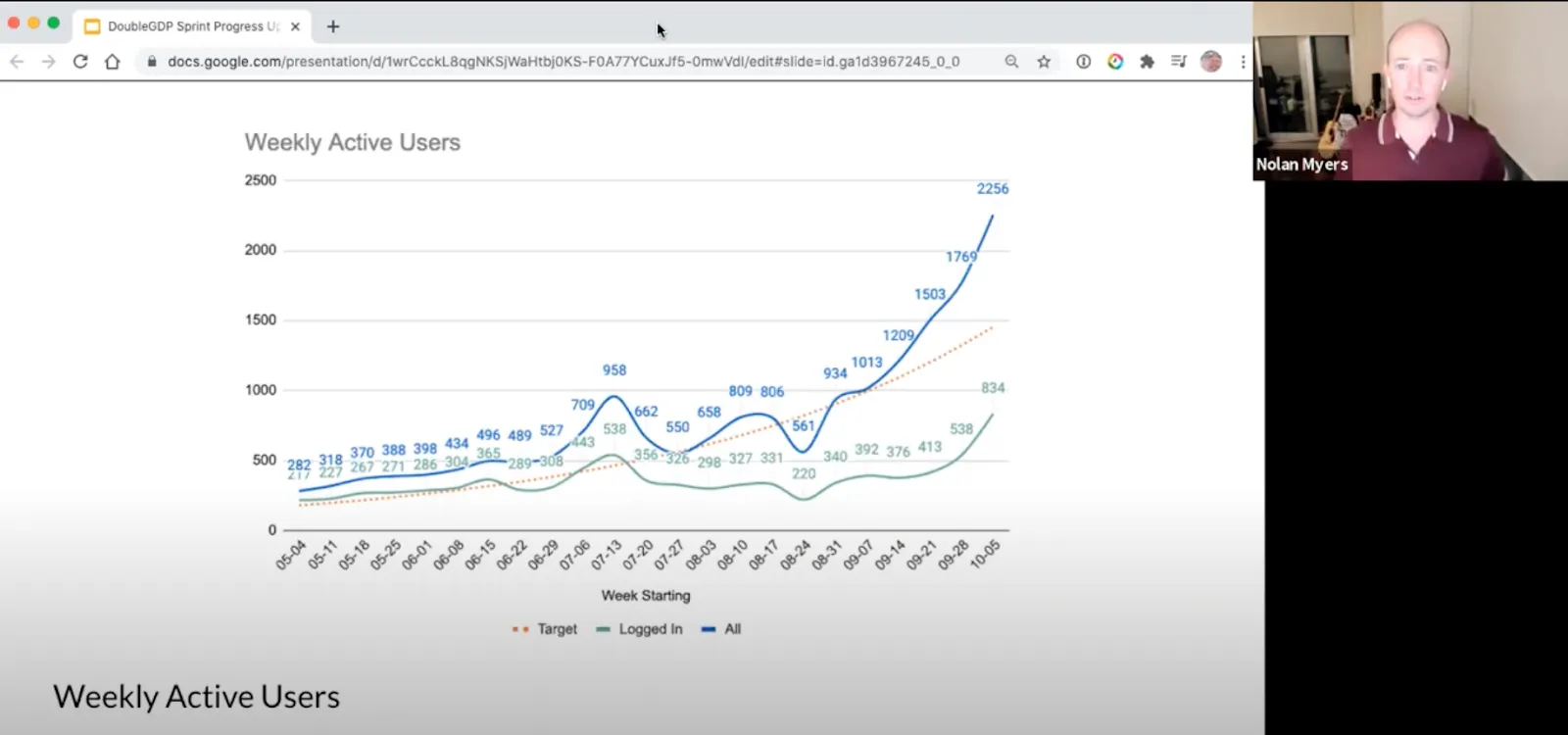
As soon as we launched our MVP we set our north star to Weekly Active Users (WAUs) with an aggressive goal of growing 10% week over week. We aligned product, customer success, and business development around achievement of this and reported it publicly on YouTube at the end of every two week sprint update. Importantly, we also aligned with our one pilot customer around this goal with a mutual investment in its success.
As expected (and to some extent intended) the goal drove our behavior. I never wanted to give an update where we fell behind target, and whenever we did we had an all-company meeting to discuss how to adjust our approach. Our product roadmap became first “what do we to hit goal” and second “what else do we think will be valuable?” We started building all sorts of user-engagement features that we had not imagined important at first, and because our customer had so few users we quickly veered toward being their communication platform with prospective residents.
Our customer loved this. Our north star had led us to discover that marketing to new customers was in fact their most urgent problem. And I loved the growth mindset it instilled throughout our company; we had unified purpose even as we grew the team.
Second Draft - Residents
We grew from nothing to a product and operations where we reliably had over 1000 weekly active users, and most importantly knew how to drive this traffic. However, as we turned the corner of 2000 WAUs we became convinced that our tactics from content-marketing playbooks no longer aligned with the value we wanted to offer our customers. So we switched.
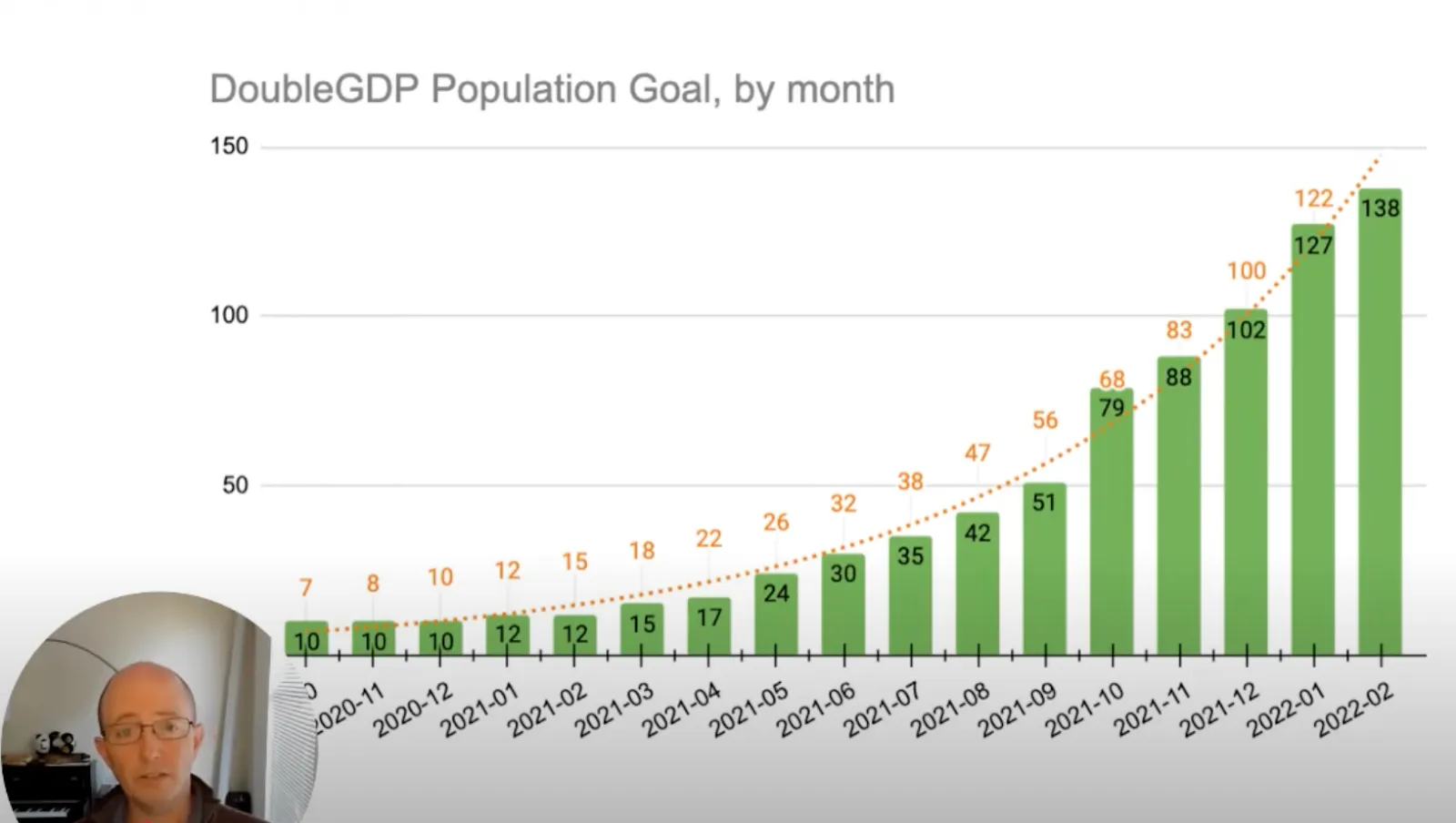
Our revised thinking led us to think of population. Our mission was to double the world’s GDP, and our impact would mirror the number of people living in cities powered by our platform. At this point in our development, we powered a still-nascent city with some buildings but no residents and we felt it was time to change. So we set our goal to increase the number of residents, ultimately from 0 to 100 by end of year.
We knew this no longer was simply a product goal but one that meant we would need to learn our customer’s business. We were inspired by Paul Graham’s “Do things that don’t scale” essay and how early startups like AirBnb recruiting users door-to-door and hiring professional photographers to improve the listings.
Again, the level of innovation the goal required drove us far afield from our initial roadmap. We co-developed residency programs with our customer. Our Artist-In-Residence program brought artists from across the country to live on site and build public art; our Hackers-In-Residence leveraged online learning and brought young software developers to live temporarily on-site. The hubbub around the community caught the eye of many people and by the end of the year full-time residents started moving in.
And again, the growth mindset, camaraderie, and skills hitting this goal drove led us to create value and expertise that was noticed and became highly sought. Had the company survived, this would have been the foundation of our success story.
Our final north star: Revenue
We had a problem. Have you heard about the new city movement? Most of you will say no, and that ultimately rendered the accomplishment we had achieved moot. We were a startup company in a startup market; our fundamental bet from the outset was that new cities were poised for growth, and that we could thus position ourselves in pole position as this new market formed.
By the end of 2022, it was clear that new cities were still years away from becoming mainstream. We weren’t able to wait, and thus we pivoted the company once more and selected the most straightforward NSM available: revenue.
Again, this reflected our strategy and drove all-company behavior. We began looking for existing markets that could use our software, meeting property developers across Africa and learning more about competitive offerings. (These are investigations I recommend other startups do early and often, and usually get attention in investment cycles.)
We ultimately concluded that none of the available paths met the investment goals we had set from the outset and decided not to continue. (The myriad reasons for this yielded many valuable lessons to explore other posts.) We had not made much traction against this north star, yet even its definition had shined enough light on our path to know where we needed to go.
Lessons Learned
A few important lessons that I will highlight:
#1 Pick a meaningful north star
You want a metric that’s valuable, actionable, investable. It needs to be a relatively good proxy of value for your company, your customers, and your investors. It should be straightforward enough to be immediately understandable, and actionable enough that your team can influence it in short iterations. And it should be compelling enough that showing its growth alone should pique the interest from your next round of investors or customers.
#2 Build your company rituals around achieving it
If you’ve picked a good metric, it’s worth optimizing. And that means building important rituals around it. Report your target and how you well you did on every iteration. When you miss it, invite critical thought about what went wrong and how to correct it. De-prioritize the things (even the seemingly strategic ones) that are not needed to hit it. At the end of the day, growth in your NSM will buy you the opportunity to come back and invest in those strategic things later, strategic investments without growth will not.
#3 It doesn’t need to be perfect in order to yield great results
Growth is key for a startup. A north star metric – one that is aligned and built around – gives you the best chance of having a compelling growth story.
Pursuit of the metric will instill in your team a growth mindset and help you shape important company rituals. You also can change it if you need. The company-wide communications that go into changing it can go a long way toward shaping your culture and sharing the understanding as to why you changed it.
But more importantly, growth – even of an imperfect metric – will make you a compelling company. Of the hypotheticals that play in my mind about shuttering DoubleGDP, the most intriguing is what we might have achieved had we continued to grow our “population” metric another year or two rather than switching to revenue. At our 20% MoM growth rate, in another year we would have over 1200 people living in cities “powered by DoubleGDP.” By Jan 2024, we would have over 10,000 residents! Ask yourself: as an investor, would you want to meet with a company running the CRM for cities with over 10,000 residents? Even if they had little or no revenue, I would bet the answer is yes.
#4 Tune your growth rate to your funding cycles
YC recommends a very aggressive 5-10% week over week growth rate. This is fantastic for an early accelerator where companies likely start on a small base and have a funding milestone after three months. However, it can’t be maintained for years – if we had kept up our 10% WoW growth of our original NSM until Jan 2024 the math shows us just shy of 14 billion weekly active users! Great growth but clearly not possible given a world population of only 8 billion.
For timelines longer than a few months, you might look to Sid Sijbrandij’s WoW Rule or the T2D3 Framework by Neeraj Agrawal. These both are geared toward revenue, but have applicability to your metric. What’s most important is that you work backward from a number that will show convincing growth and also give you a challenging target on the timeline you need.